






In short
For a day hike, 20 to 30 litres are enough, for hut-to-hut tours 30 to 40 litres, for the Camino de Santiago 40 to 50 litres, and for multi-day tours with a tent 50 to 70 litres. Just as important as the volume is the back length: only if it fits properly will the weight sit on your hips instead of your shoulders.
A backpack that's too small forces you to leave essentials at home. One that's too big tempts you to overpack, and you'll feel every extra kilo after a few hours. Here you'll find the right litre size for your tour, learn how to measure your back length, and what to look out for with women's models and for tall people.
Backpack size chart: how many litres for which tour?
Backpacks are categorised by their volume in litres. How much you need depends on the length of the tour, your overnight arrangements and your packing style.
| Tour | Duration | Volume | Backpack type |
|---|---|---|---|
| Walk, city, short outing | a few hours | up to 15 l | Day packs |
| Day hike | 1 day | 15 to 30 l | Hiking backpack |
| Hut-to-hut tour, high-altitude tour | 2 to 4 days with huts | 30 to 40 l | Hiking backpack, small trekking backpack |
| Camino de Santiago, long-distance trail | 1 to 6 weeks with accommodation | 40 to 50 l | Trekking backpack |
| Trekking with a tent | several days without huts | 50 to 70 l | Trekking backpack |
| Long tours without resupply | from 2 weeks | from 70 l | large trekking backpack |
Guideline values. With lightweight gear you can get by with less (more on this in our guide Ultralight Trekking); in winter you'll need around 10 litres more because of bulkier clothing.
The four most common tours and suitable backpacks
Day hike
20 to 30 l
Food, water or a hydration bladder, rain jacket, warm layer, first-aid kit. A ventilated mesh back panel keeps you drier on warm days.
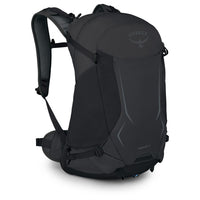
 OspreyOsprey Hikelite 2626 l, ventilated mesh back panel
Hut-to-hut tour
30 to 40 l
Change of clothes, hut sleeping bag liner, toiletries and a head torch. Tent and stove stay at home, so a slim backpack with a sturdy hip belt is enough.
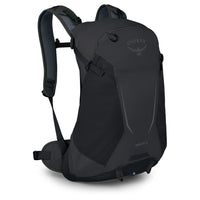
 OspreyOsprey Kestrel 38 L/XL38 l, adjustable back length
Camino de Santiago
40 to 50 l
You carry everything every day. Pack for around a week and do laundry along the way. A low pack weight and a well-padded hip belt pay off on long stages.
 DeuterDeuter Aircontact Lite 40 + 1040 + 10 l, extendable lid
Trekking with a tent
50 to 70 l
Tent, sleeping bag, sleeping mat, stove and food for several days. Here, what matters is a carrying system that safely transfers 15 kilos or more onto your hips.
 OspreyOsprey Atmos AG LT 65 L/XL65 l, mesh back panel with load transfer
You'll find more models among our hiking backpacks, sorted by volume and brand, for example from Deuter and Osprey.
Measuring your back length: here's how
Back length is the distance between the seventh cervical vertebra and the top edge of your pelvis. It has less to do with height than many people think: two people of the same height can have different back lengths. The easiest way to measure is with a second person:
- Tilt your head slightly forward. The vertebra that protrudes most clearly at the transition from neck to back is the seventh cervical vertebra. This is the upper measuring point.
- Place your hands on your hips so that your thumbs point backwards and your index fingers rest on top of your hip bones.
- The imaginary line between the two thumbs at the level of the top of the pelvis is the lower measuring point.
- Measure with a flexible tape measure along the spine from the upper to the lower point.
| Back length | Backpack size (guideline) |
|---|---|
| up to approx. 40 cm | XS or women's size WXS/S |
| approx. 40 to 45 cm | S |
| approx. 45 to 50 cm | M |
| approx. 50 to 55 cm | L |
| over approx. 55 cm | XL or Extra-Long model (EL) |
Every manufacturer has its own size charts; the values above are a general guide. Models with an adjustable back length cover several sizes and can be adjusted afterwards.
Women's models: SL, WXS/S and more
Women's backpacks aren't just smaller. They usually have a shorter back length, narrower and differently shaped shoulder straps, and a more tapered hip belt. With Deuter you'll recognise them by the SL (Slim Line) suffix, with Osprey by sizes such as WXS/S or WM/L. Men with a short back or narrow shoulders often find these models more comfortable too.
 DeuterDeuter Futura 21 SL21 l, day tour, SL fit
 OspreyOsprey Aura AG LT 65 WXS/S65 l, trekking, size WXS/S
You'll find a wider selection among our women's hiking backpacks.
Hiking backpacks for tall people
From a back length of around 55 centimetres, standard sizes start to fall short: the hip belt slides up above the pelvis, and the weight ends up hanging from the shoulders. Two solutions help:
- Extra-Long models: Deuter makes some backpacks as EL versions with a longer back, for example the Futura 34 EL.
- L/XL sizes and adjustable backs: Osprey offers many trekking backpacks in L/XL, and with adjustable back systems you simply slide the shoulder straps further up.


Checking the fit: 5 points to go through when trying it on
You can only tell whether a backpack fits once it has weight in it. For the fitting, pack 8 to 10 kilos inside and go through the points from bottom to top:
- Hip belt: The padding wraps around the hip bones, and the belt sits on the iliac crest. It carries most of the weight.
- Shoulder straps: They rest against the shoulders without any gap and don't press against the sides of the neck.
- Load lifter straps: The short straps at the top of the shoulder straps pull the load in towards the body. An angle of around 45 degrees is ideal.
- Sternum strap: It sits at chest height and holds the shoulder straps together without restricting breathing.
- Test on the move: Walk around for a few minutes, including stairs. Nothing should chafe, and the backpack shouldn't pull backwards.
Frequently asked questions about backpack size
What backpack size do I need for a week?
If you're staying in huts, guesthouses or hostels, 40 to 50 litres are enough. With a tent, sleeping bag and stove, you'll need 50 to 70 litres. Plan to do laundry along the way so you don't have to carry fresh clothes for every single day.
What backpack size for two or three weeks?
If you can wash and shop along the way, the backpack barely needs to grow with the duration: 40 to 50 litres with accommodation, 50 to 70 litres with a tent. Without resupply and carrying food for many days, 70 litres or more makes sense.
How many litres do I need for a day hike?
Usually 20 to 30 litres. That leaves room for food, water, a rain jacket, a warm layer and a first-aid kit. For short summer outings, 15 to 20 litres are enough; in winter, or if you're carrying gear for children, 30 litres is more comfortable.
What does 40 + 10 mean on a backpack?
The first number is the base volume, the second is the additional volume. Thanks to a liftable lid and an extendable collar, a 40 + 10 backpack can hold around 50 litres when needed, for example for food supplies on the first few days.
How heavy can a packed hiking backpack be?
As a rule of thumb: a day pack should weigh no more than about a tenth of your body weight, a trekking backpack no more than a fifth. The better the hip belt fits, the lighter the weight feels to carry.
What does the size "misc" mean on a backpack?
"Misc" stands for "miscellaneous". Retailers and manufacturers use it for one-size-fits-all items or models without a fixed size range. In that case, what matters for the fit is the stated back length or an adjustable back system.